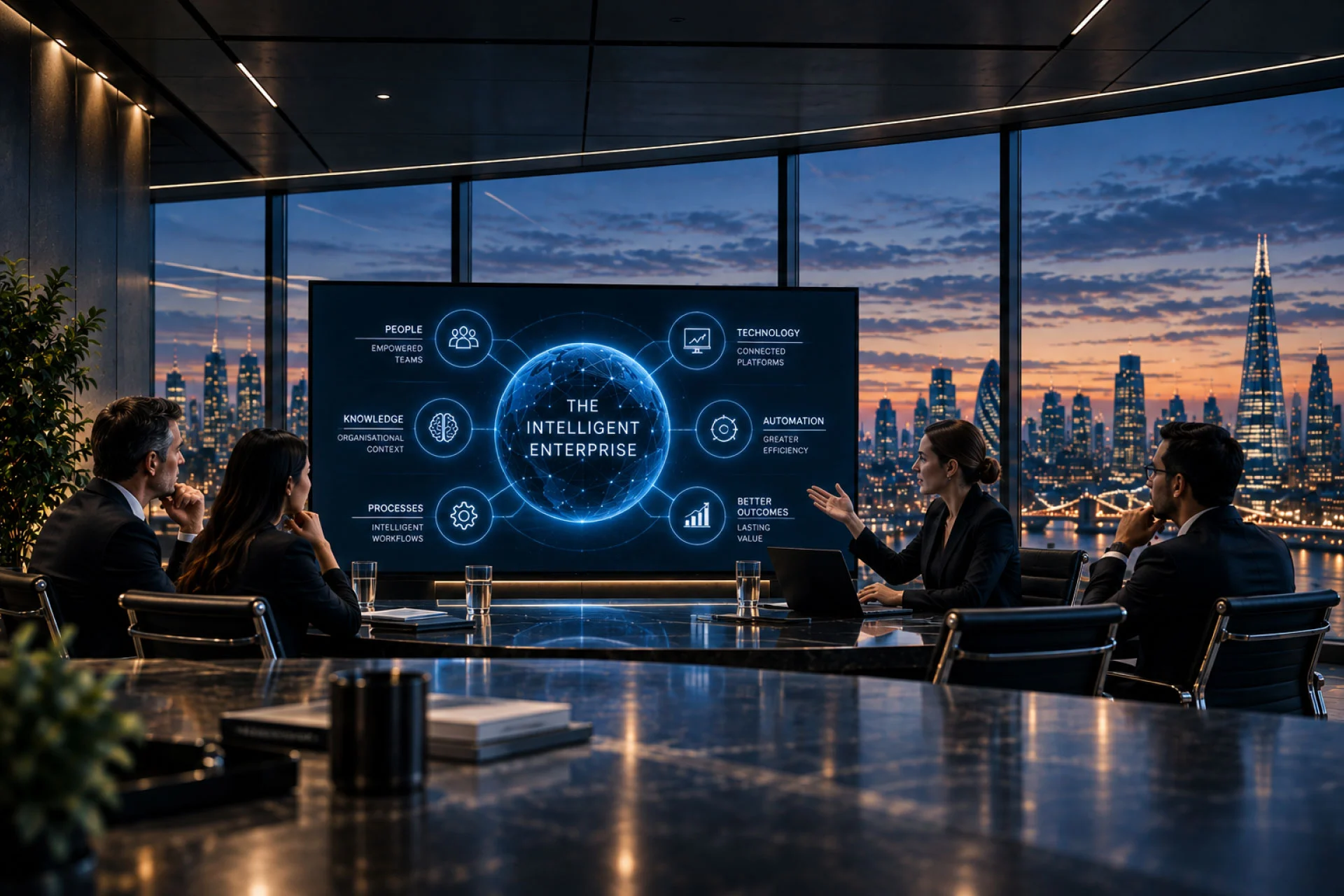
Artificial intelligence is often introduced into organisations through individual use cases. A team adopts an assistant, a process becomes automated, or a new system uses intelligence to analyse information and support decisions.
Each improvement can create value. The larger opportunity appears when those capabilities begin working together.
An intelligent enterprise connects artificial intelligence with the systems, information, processes and people that already make the organisation function. Intelligence is not confined to one application or department. It becomes available across the business where there is a legitimate purpose for using it.
This changes the conversation around enterprise AI.
The objective is no longer simply to identify tasks that artificial intelligence can perform. Organisations can begin considering how intelligence might improve the way information moves, how work is coordinated, how knowledge is accessed and how people interact with increasingly complex technology environments.
The result is not an autonomous organisation. It is an organisation capable of using technology more intelligently while retaining appropriate human authority and accountability.
Intelligence Becomes More Valuable When It Is Connected
An AI system operating independently can only work with the information and capabilities available within its immediate environment.
Connect intelligence appropriately across an organisation and its usefulness can expand considerably.
Customer information can provide context for service activity. Organisational knowledge can support employees as they work. Operational systems can provide current information about what is happening across the business. Workflows can allow intelligence to assist with practical activities rather than simply produce answers.
The important word is appropriately.
Enterprise connectivity requires permissions, identity, security and clear boundaries around what information and capabilities different people and systems can access. Intelligence should not bypass those controls. It should operate within them.
This combination of connectivity and control provides the foundation for a more intelligent operating environment.
Instead of introducing AI as another isolated layer of technology, organisations can begin integrating intelligence with the systems and processes through which work already happens.

From Individual Capabilities to an Intelligent Operating Environment
The intelligent enterprise is not created through a single system, model or technology programme.
It develops as different capabilities begin reinforcing one another.
Enterprise knowledge gives intelligence useful organisational context. Connected platforms provide access to systems and information. Automation allows defined activities to move through workflows with less manual intervention. Digital coworkers can help people interact with those capabilities more naturally. Human oversight maintains judgement and accountability where they remain important.
Individually, each capability can improve a particular part of the organisation. Together, they can change how work moves through the business.
An employee may no longer need to know which system contains a particular piece of information. A routine process may progress automatically until a decision requires human involvement. Relevant organisational knowledge can appear within the context of the work being performed rather than requiring a separate search.
The underlying complexity does not disappear. It becomes better coordinated.
This is an important distinction. The purpose of enterprise intelligence is not to hide every system behind artificial intelligence or automate every activity. It is to create an operating environment in which technology works together more effectively and becomes easier for people to use.
As these capabilities mature, the competitive distinction may increasingly lie not in whether an organisation has access to AI, but in how successfully it integrates intelligence into the way the business actually operates.
For 15.Group, the intelligent enterprise represents that wider opportunity: connecting technology, knowledge, processes and people so intelligence becomes part of how the organisation works, rather than another capability sitting alongside it.