
Enterprise technology rarely develops according to a single plan.
New systems are introduced as organisations grow. Departments adopt specialist applications. Acquisitions bring additional infrastructure. Older platforms remain because important processes still depend on them.
Over time, the result can be a technology environment containing hundreds of applications, integrations, databases and overlapping sources of information.
Artificial intelligence enters this existing landscape.
That matters because AI does not automatically resolve the complexity beneath it. An intelligent system may still need reliable access to information, appropriate permissions and connections with the applications where work is performed.
If those foundations are fragmented, introducing intelligence can reveal the problem rather than solve it.
Enterprise architecture therefore becomes increasingly important as organisations move beyond isolated AI experiments and begin connecting intelligence with operational systems.
Architecture Determines What Can Connect
The purpose of enterprise architecture is not simply to produce diagrams describing technology.
It establishes how important parts of the organisation’s technology environment relate to one another.
Identity determines who or what can access a capability. Integration allows systems to exchange information. Data structures influence whether information can be interpreted consistently. Permissions establish boundaries. Shared services can prevent every application from solving the same problem independently.
These decisions affect how easily an organisation can introduce new capabilities later.
A well-structured environment does not require every system to be identical or replaced by a single platform. Different applications can continue serving different purposes while operating within an architecture that provides appropriate ways for them to connect.
This becomes particularly important with AI because intelligence may need to work across several systems during a single activity.
The architecture underneath the experience determines whether that interaction is coherent, controlled and practical at enterprise scale.
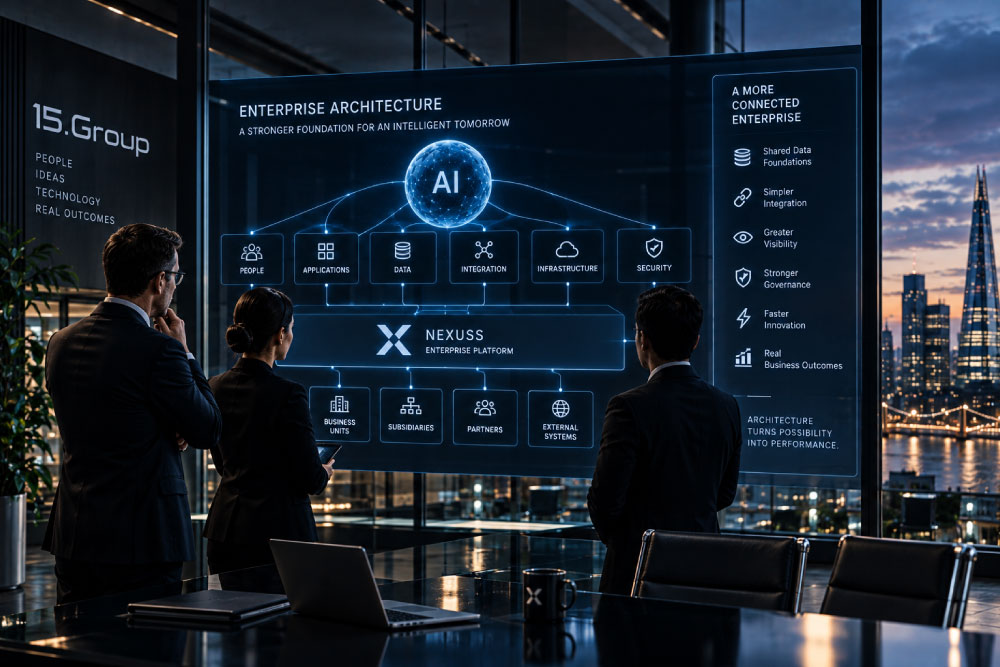
Architecture Creates Room for Change
Enterprise architecture should not be confused with rigidity.
A well-designed architecture can make change easier because organisations understand where new capabilities belong, how they should connect and which shared services are already available.
This becomes increasingly valuable as technology develops more quickly.
An organisation may adopt a new AI capability today and replace it with something more capable later. Business units may require specialist applications. New companies may join through acquisition. Existing systems may need to remain operational while newer services are introduced around them.
Architecture provides continuity through that change.
Rather than allowing every new requirement to create another isolated technology stack, organisations can establish common foundations for identity, integration, information access, security and governance. New capabilities can then connect with those foundations instead of recreating them independently.
This approach can also reduce dependency on individual technologies. AI models, applications and infrastructure can evolve while the wider enterprise retains a consistent way of managing access, information and interaction between systems.
The result is not a perfectly uniform technology environment. Large organisations rarely operate that way.
It is an environment where complexity is structured sufficiently to remain understandable, connected and adaptable.
For 15.Group, this is why enterprise architecture matters increasingly in the age of AI. The technologies will continue to change. The organisation still needs foundations capable of changing with them.