AI governance is often discussed through principles.
Organisations establish policies covering responsible use, privacy, security, transparency and human oversight. These provide an important framework for determining how artificial intelligence should be used.
The challenge begins when those principles encounter everyday operations.
An AI system may need access to organisational information. An automated process might be permitted to update a business record. A digital coworker could operate across several applications. Another system may recommend an action with financial or customer consequences.
At that point, governance needs to do more than describe acceptable behaviour.
It needs to influence what the technology is actually capable of doing.
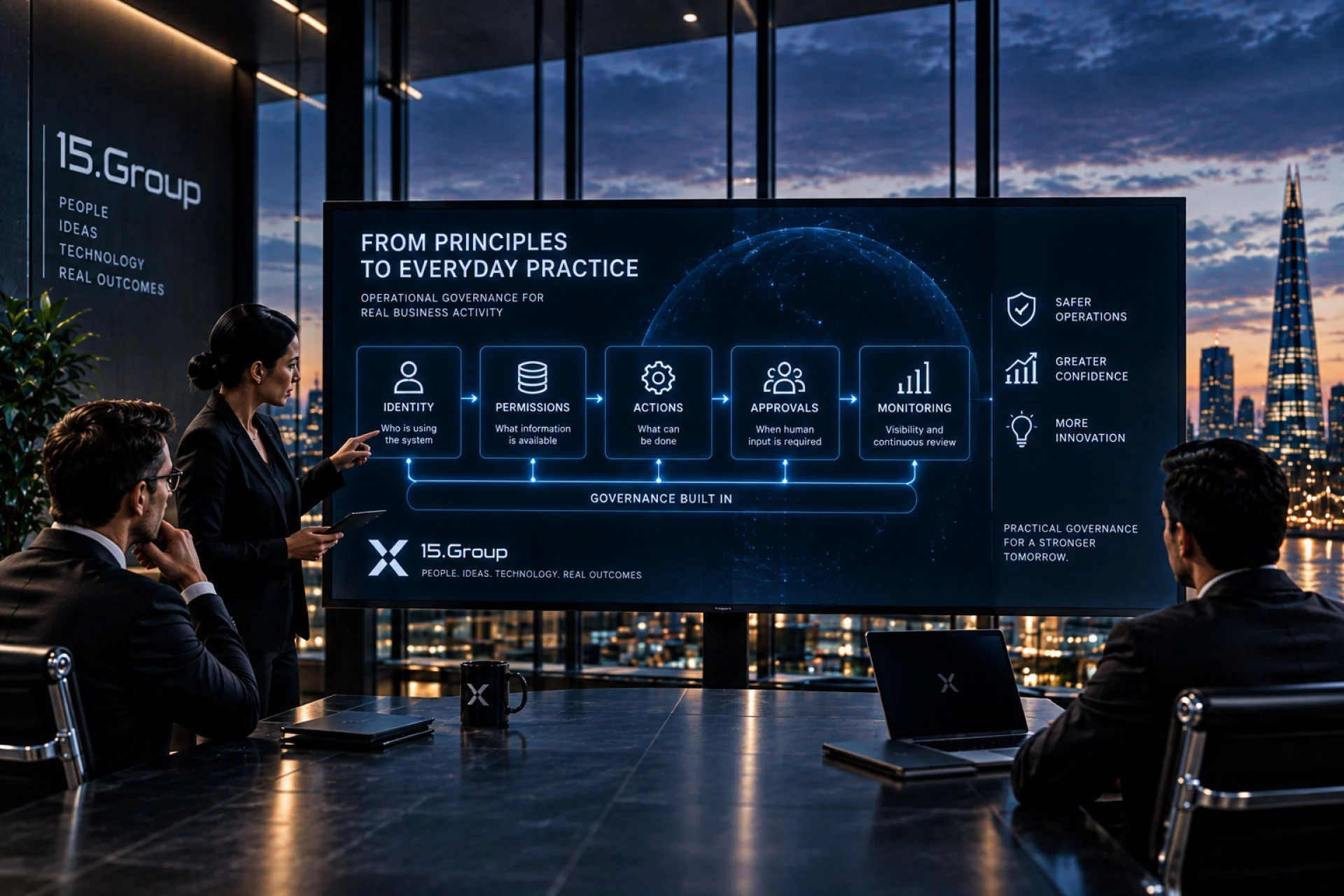
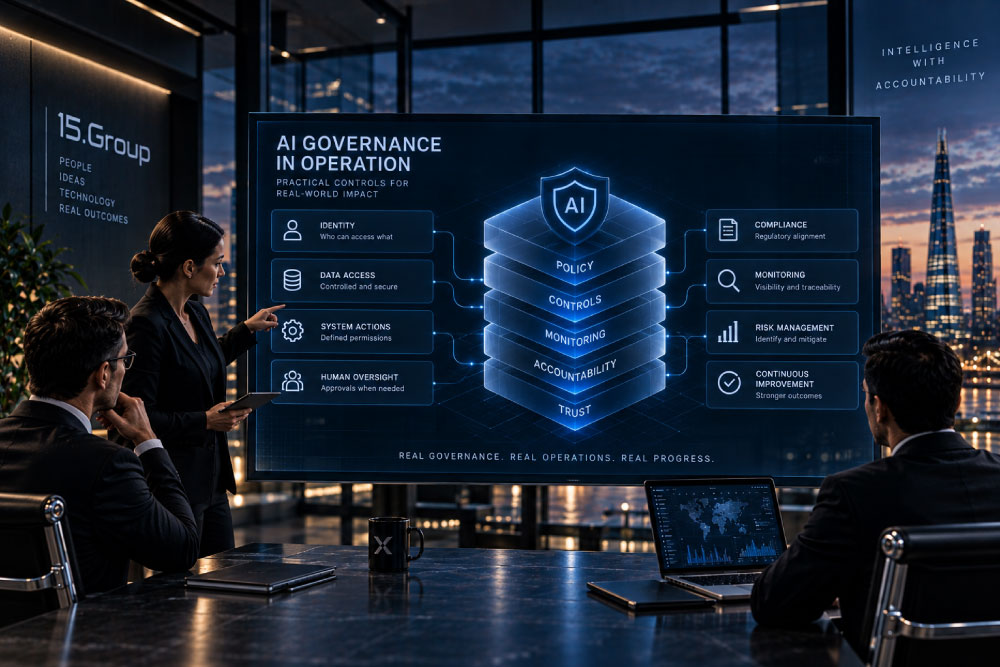
This requires organisations to translate policy into practical controls across identity, permissions, information access, system actions, approvals and monitoring.
Governance Needs to Exist Inside the System
Effective governance should operate as close as possible to the activity being governed.
If an intelligent system can access sensitive information, permissions should determine precisely what it can retrieve. If automation can initiate an action, its authority should be defined. Where human approval is required, that decision point should form part of the workflow rather than depend entirely on someone remembering a policy.
The same principle applies to accountability.
Organisations need sufficient visibility to understand which system performed an action, what information was involved and where responsibility sits when intervention becomes necessary.
These controls do not need to prevent useful automation.
Their purpose is to establish boundaries within which intelligent systems can operate confidently. Routine, low-risk activity may require relatively little intervention, while actions carrying greater commercial, regulatory or operational consequences can operate under tighter controls.
Governance then becomes part of the enterprise architecture rather than a document sitting alongside it.
The objective is to create practical guardrails that allow organisations to use AI while retaining appropriate control over information, actions and accountability.
From Principles to Everyday Practice
Operational governance becomes most effective when it is designed into normal business activity rather than introduced as an additional administrative layer.
Employees should not need to interpret a governance framework every time they interact with an intelligent system. Appropriate controls can instead operate through the technology itself.
Identity can establish who is using a system. Permissions can determine which information is available. Defined authority can restrict which actions an automated capability may perform. Approval workflows can introduce human involvement when particular thresholds or conditions are reached.
Monitoring can then provide visibility into how those capabilities are being used and where controls may need to change.
This makes governance dynamic.
An organisation may initially require human approval for a particular AI-supported action. As experience develops and evidence demonstrates consistent performance, the level of autonomy might change. Conversely, new risks or regulatory requirements may justify tighter controls.
Governance therefore needs to evolve alongside the systems it governs.
This approach also supports innovation. Teams can explore useful applications of artificial intelligence within clearly understood boundaries rather than treating governance as something considered only after technology has been deployed.
For 15.Group, operational AI governance is ultimately about creating the conditions for responsible adoption at scale. Governance should not simply define what AI is permitted to do. It should provide the mechanisms through which those decisions are applied, observed and improved.